More Autophagy, Worse Health? Why This Study Doesn't Tell the Whole Story
Scientists have long been interested in autophagy because studies in animals suggest it can contribute to healthier aging and, in some circumstances, longer life.
Autophagy is widely promoted as a way to slow aging. So what should we make of research suggesting that older people with more autophagy are actually less physically fit?
Imagine spending years believing that something helps keep your cells healthy, only to come across a headline suggesting it might be doing the opposite.
That's exactly the impression you might get from a recent study about autophagy.
On October 31, a longevity account on X posted:
"BREAKING: Scientists discover higher autophagy, the cellular cleanup process promoted for longevity, was associated with WORSE physical health in older adults, challenging assumptions about anti-aging."
The post attracted considerable attention. One commenter went further, claiming that autophagy means cell populations die off and that the idea of autophagy slowing aging is ridiculous.
But does the research really justify either conclusion?
Not quite. The findings are interesting, but there's much more to the story.
First, what is autophagy?
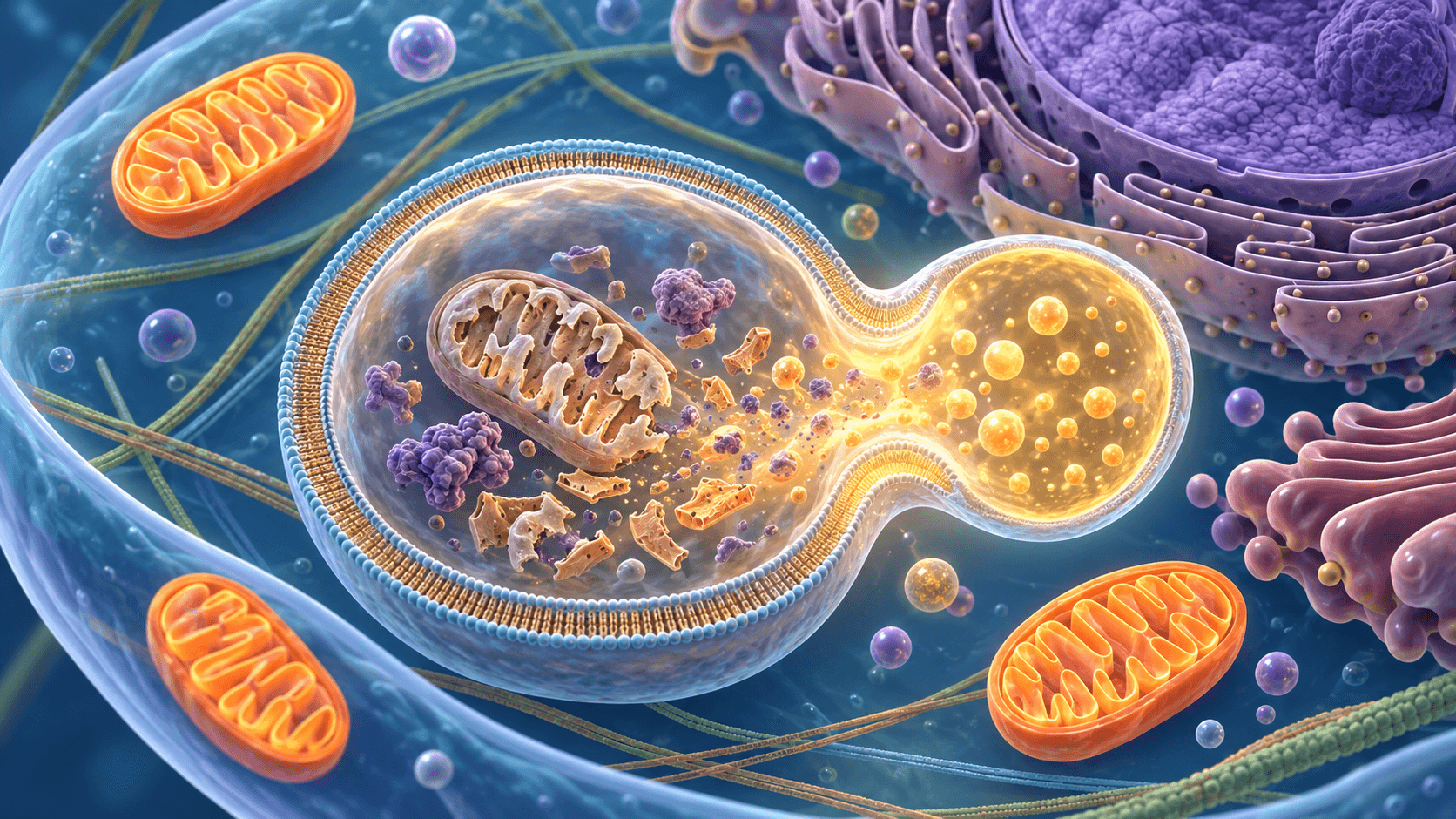
Think of autophagy as your cells' recycling system.
Throughout their lives, cells accumulate damaged proteins and worn-out components. Autophagy helps break down this material so it can be recycled.
It's one of the processes that help cells maintain themselves and function properly.
Scientists have long been interested in autophagy because studies in animals suggest it can contribute to healthier aging and, in some circumstances, longer life.
This has helped fuel interest in fasting, supplements, and other interventions intended to increase autophagy.
But there's an important question that often gets overlooked:
If autophagy is beneficial, does that mean more is always better?
That's where this new study becomes interesting.
What did the researchers actually find?
The study, published in Aging Cell in September 2026, examined autophagy in different types of human cells.
Rather than simply looking for signs that autophagy was present, the researchers tried to measure how actively the cells were recycling their components.
They studied skin cells, blood cells, and nerve-like cells generated in the laboratory from skin cells.
And they discovered something unexpected.
Autophagy didn't simply decline with age, as we might expect.
In men's skin cells, it declined. In women's skin cells, it remained relatively stable. In nerve-like cells from women, it actually increased.
Blood cells showed no clear overall relationship with age, although measurements became more variable in older participants.
Already, this challenges the idea that aging involves a straightforward decline in autophagy throughout the body.
But the finding that attracted the headlines was something else.
Among participants over 70, higher autophagy activity was associated with poorer results on some physical fitness tests.
That sounds concerning, doesn't it?
Until you look at how many people were involved.
The first problem: very few participants
The findings in people over 70 were based on groups of:
- 10 participants for blood cells
- 9 participants for skin cells
- 6 participants for nerve-like cells
That's a very small number of people on which to base conclusions about physical health and aging.
All of them were also healthy volunteers, so the results may not apply to people who are frail or living with illness.
With groups this small, one or two unusual results can make a substantial difference to the apparent relationship.
And the associations weren't equally convincing across the three cell types.
The blood-cell findings were the most consistent. The skin-cell findings provided much weaker support.
So the study identified an interesting relationship. It did not establish a general rule about autophagy and physical health.
The second problem: which comes first?
This is the most important question, and it's one the study cannot answer.
Suppose someone has poorer physical health and their cells contain more damaged material.
Their cells might respond by increasing autophagy to deal with that damage.
In that case, higher autophagy wouldn't necessarily be causing poorer health.
It might be a response to it.
Think of firefighters arriving at a burning building.
If we discovered that buildings with more firefighters tended to have worse fires, would we conclude that firefighters were causing the damage?
Of course not.
The firefighters are there because the damage is already happening.
Something similar could be occurring with autophagy.
Cells under greater stress might increase their recycling activity to cope with the problem.
The researchers themselves raise this possibility.
That's a very different interpretation from saying that autophagy is harmful.
And the study doesn't tell us which explanation is correct.
The third problem: too many comparisons, too little certainty
The researchers examined numerous combinations of cell types, age groups, and physical health measurements.
That creates a statistical problem.
When you look for relationships across many measurements, some can appear meaningful simply through chance.
This becomes especially important when the number of participants is small.
The paper does not report a correction for the many physical-health comparisons, and some highlighted results did not meet the conventional threshold for statistical significance.
That doesn't make the findings worthless.
It means we should treat them as clues worth investigating, rather than established conclusions.
What about exercise?
The researchers also ran a small exercise experiment involving five older adults, aged 77 to 88.
After 12 weeks of gentle exercise, autophagy activity fell in four of the five participants. Their average score on one physical performance test also improved.
Interesting again.
But there was no control group.
We don't know whether the changes were caused by exercise, normal variation, or other factors.
Several other physical measurements didn't improve.
Yet the paper uses language suggesting that exercise reverses elevated autophagy and returns it to more youthful levels.
I think that goes further than the evidence justifies.
The researchers weren't comparing these participants with a genuinely young group. The reference was the average from their broader study population.
A five-person exercise experiment can generate a useful hypothesis. It cannot establish that exercise reverses age-related changes in autophagy.
Does this mean the study is badly designed?
Not necessarily.
And this is where we should give the researchers credit.
One of the study's strengths is that it measured the activity of the cellular recycling process, rather than relying solely on indirect markers.
That matters because a cell can contain more autophagy-related structures without necessarily recycling material more effectively.
The study also compared different cell types and showed that autophagy changes with age are more complicated than a simple decline.
Those are useful findings.
Where the evidence becomes less convincing is when the researchers try to connect those laboratory measurements with physical health, particularly in the very small groups of older participants.
In other words, the study is more convincing about how autophagy behaves in different cells than about what higher autophagy means for your health.
That's an important distinction.
So did the X post get it wrong?
Not entirely.
The post correctly said that higher autophagy was associated with poorer physical function in older adults.
It didn't claim that one caused the other.
And the suggestion that the findings challenge some assumptions about anti-aging reflects the researchers' own discussion.
But the post left out the information readers needed to judge how convincing the findings were.
There was no mention of the small participant groups, the uncertainty about cause and effect, or the fact that autophagy was measured in cell samples.
The dramatic "BREAKING" introduction also made the discovery sound more immediate than it was. The findings had already appeared in a preprint in May.
The commenter who claimed that autophagy means cell populations die off went much further.
That's not what autophagy generally means. It's primarily a process that recycles components inside living cells, rather than a process in which whole populations of cells die.
And the suggestion that the idea of autophagy slowing aging is ridiculous is not supported by this study.
The researchers didn't measure lifespan or the rate of aging.
What does this mean for longevity supplements?
This is where the findings become relevant to anyone interested in fasting, spermidine, urolithin A, or other interventions promoted for their supposed effects on autophagy.
The study doesn't establish that increasing autophagy through any of these interventions is harmful.
But it doesn't establish that doing so is beneficial either.
None of these interventions was tested.
What the study does suggest is that the relationship between autophagy and healthy aging may be more complicated than simply turning up the body's cellular recycling system.
A higher level of activity might sometimes indicate that cells are responding to greater stress.
That's worth understanding before assuming that anything marketed as an autophagy booster must be good for you.
My conclusion
I wouldn't dismiss this study. It makes a useful contribution to our understanding of how autophagy changes with age.
But I wouldn't use it to argue that autophagy is harmful or that decades of longevity research have been overturned.
The evidence doesn't support either conclusion.
The most interesting finding, in my view, is that higher autophagy doesn't automatically mean healthier cells.
Sometimes it might mean those cells have more damage to deal with.
That's a distinction worth investigating.
And it's also a reminder of something I think matters whenever we read a dramatic scientific headline:
Before asking whether a study challenges what we believe, we should ask whether its evidence is strong enough to justify the challenge.
Sources
- Moreno TM et al. (2026). Autophagy Flux Is Remodeled Sex- and Cell Type-Specifically During Human Aging, and Is Linked to Reduced Physical Function in Older Adults. Aging Cell. Read the study.
- Original bioRxiv preprint, May 2026.
- Sanford Burnham Prebys press release, October 2026.
- Original X post.